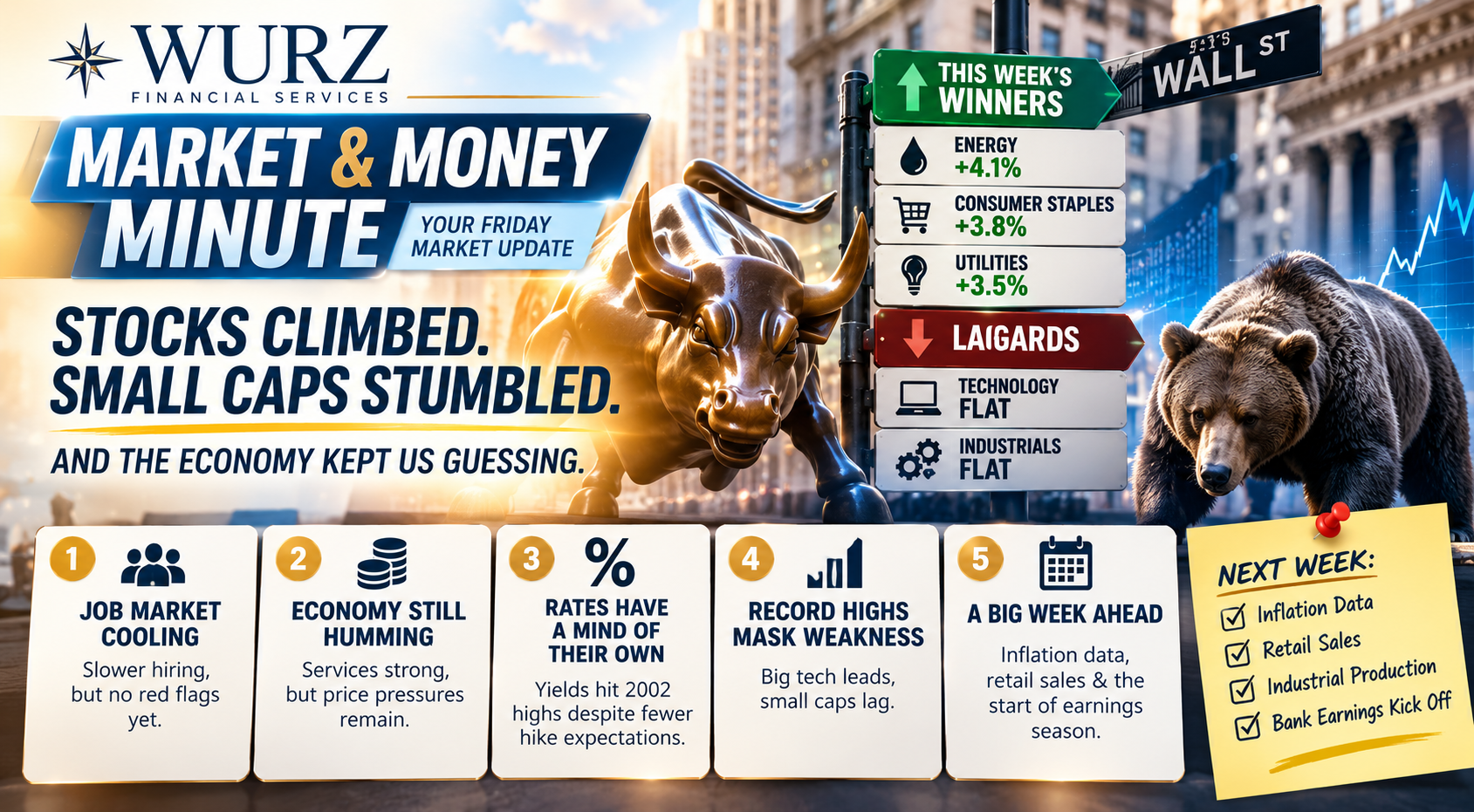
Stocks Climbed. Small Caps Stumbled. And the Economy Kept Us Guessing.
THE WEEK IN REVIEW
Wall Street had another winning week—well, mostly.
The S&P 500 gained 1.3%, and the Nasdaq rose 0.7%, but smaller companies weren’t invited to the party. The Russell 2000 slipped 0.5%.
The surprise? This week’s winners weren’t the usual technology giants. Energy jumped 4.1%, Consumer Staples (everyday essentials) gained 3.8%, and Utilities climbed 3.5%. Value stocks (+1.5%) also outpaced Growth (+1.1%).
Technology and Industrials? Flat as a pancake.
Bonds managed modest gains as Treasury yields eased by week’s end. Meanwhile, oil fell 2.2%, the dollar barely budged, and the VIX (Wall Street’s fear gauge) settled near a relatively calm 15.
BOTTOM LINE: Stocks moved higher, but the leadership changed. Sometimes the market’s supporting cast steals the show.
5 THINGS WORTH KNOWING
1. THE JOB MARKET IS COOLING—NOT CRASHING
Employers added just 29,000 jobs in September, below the prior year’s monthly average of 45,000. Earlier job estimates were revised downward by a combined 60,000, and unemployment edged up to 4.2%.
But here’s the encouraging part: New unemployment claims remain near 200,000, historically low territory.
* WHAT IT MEANS: Companies are hiring more cautiously, but we’re not seeing widespread layoffs. Think slowdown, not meltdown.
2. THE ECONOMY IS STILL HUMMING. PRICES? NOT SO MUCH.
The services sector—everything from restaurants to healthcare—remains healthy. September’s ISM Services Index registered 54.9, comfortably above the 50 mark that signals growth.
The catch? The Prices Index hit 74.0, its highest since July 2022. Businesses are still feeling the squeeze.
WHAT IT MEANS: Economic activity remains solid, but inflation pressures aren’t disappearing quietly.
3. INTEREST RATES AREN’T TAKING ORDERS FROM THE FED
Markets saw less than a 20% chance of another Fed rate hike in October. Yet longer-term Treasury yields surged early in the week, with the 10-year reaching 5.35% and the 30-year briefly topping 5.70%—levels not seen since 2002.
Why? Inflation concerns, government borrowing, oil prices, and global bond pressures all played a role.
WHAT IT MEANS: Even if the Fed takes its foot off the gas, mortgage rates and other long-term borrowing costs don’t necessarily follow. The Fed isn’t the only driver.
4. RECORD HIGHS DON’T TELL THE WHOLE STORY
The S&P 500 and Nasdaq reached fresh highs, but smaller companies are struggling. The Russell 2000 sits nearly 9% below its August peak.
Big technology companies have helped carry the major indexes, while higher interest rates have weighed on smaller businesses.
WHAT IT MEANS: A handful of big winners can make the market look healthier than it really is. It’s worth looking beyond the headlines.
5. NEXT WEEK: INFLATION, EARNINGS & PLENTY OF HEADLINES
Get ready for a busy economic calendar:
- Wednesday: Consumer inflation report
- Thursday: Producer inflation and retail sales
- Friday: Industrial production
Plus, third-quarter earnings season kicks off, with major Wall Street banks reporting their results.
We’ll be watching what these numbers reveal about inflation, consumer spending, lending, and business confidence.
WHAT IT MEANS: Next week’s reports should give us a clearer picture of where the economy is headed—or at least a few more pieces of the puzzle.
THE WURZ TAKEAWAY
The market doesn’t move in a straight line, and neither does the economy.
Jobs are slowing, prices remain stubborn, and some stocks are doing much better than others. That’s precisely why a sound financial strategy shouldn’t depend on guessing what next week’s headlines will say.
Stay informed. Stay diversified. And don’t let a week’s worth of headlines rewrite a lifetime of financial planning
If anything in this blog has you asking questions about your investment prospects book a free call – we’d love to answer any questions you might have!