What Your Money Did Last Month
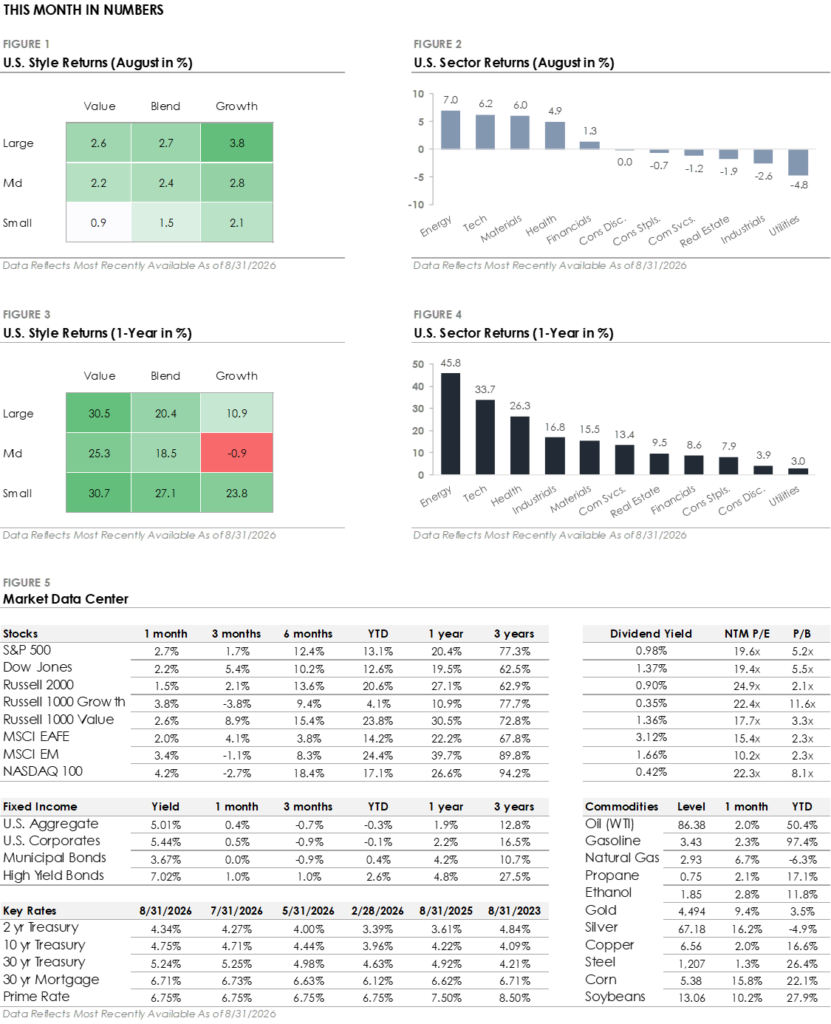
- The S&P 500 had a great August, gaining +2.7% and hitting a new record high. Energy stocks led the pack (+7.0%), with Tech (+6.2%) bouncing back from a rough July and Materials (+6.0%) riding gold’s nearly +10% surge. Utilities, Industrials, and Real Estate were this month’s laggards — nobody’s throwing them a parade.
- Bonds edged higher too, even though interest rates climbed all month — the U.S. Bond Aggregate returned +0.4%. Corporate bonds did a bit better (+0.5%), and higher-risk “high-yield” bonds led the group at +1.0%.
- International stocks had a good month as well. Developed markets rose +2.0% (trailing the S&P 500), while emerging markets jumped +3.4% — outperforming as tech stocks overseas rallied right alongside U.S. tech.
Rates Went Up. Stocks Didn’t Care.
Stocks climbed in August, and the strength wasn’t limited to one corner of the market. The S&P 500, Dow Jones, Russell 2000, and the “equal-weight” S&P 500 (a version that doesn’t let a handful of giant companies dominate the number) all hit new all-time highs, and the Nasdaq 100 came close to its own record. That’s notable, because these indexes track very different types of companies — from massive tech giants to small, scrappy ones. All year, market leadership has bounced back and forth between a narrow group of winners and a broader rally. August was firmly in the “broad rally” camp, with strength spread across a wide range of companies — seemingly everyone showed up to the party.
Here’s the part that should genuinely raise an eyebrow: interest rates rose all month — the kind of thing that usually spooks stocks — and stocks went up anyway. The rate on the 10-year Treasury bond climbed above 4.75%, its highest point since January 2025, and the 30-year approached 5.30%, a level we haven’t seen since 2007 (back when flip phones were still a thing). Blame a mix of stubborn inflation, heavy government borrowing, and jitters about energy prices. Late in the month, new Fed Chair Kevin Warsh gave a speech suggesting the Fed’s next move might be raising rates rather than cutting them, which pushed rates up even further. The reassuring part: even with all this rate drama, corporate “credit spreads” (basically, how nervous lenders are about getting repaid) stayed calm and near record lows. Translation: Wall Street is stressed about interest rates, not about companies’ ability to pay their bills.
Oil, the Middle East, and AI: The Market’s Two Favorite Storylines
Geopolitics has dominated headlines all year, but its grip on the market has loosened. Oil prices still jump whenever there’s fresh news out of the Middle East — that hasn’t changed. What has changed is how the rest of the market reacts. Earlier this year, the start of the conflict and disruption in the Strait of Hormuz sent oil prices surging and dragged stocks down with it. Since then, we’ve seen several rounds of tension rising and falling, and investors have grown a bit numb to it — increasingly waiting to see if a headline will actually affect energy supply, inflation, or growth before reacting the way they did back in March.
The other big storyline is artificial intelligence. Investors are still debating whether all the money pouring into data centers, computer chips, power plants, and networking gear will eventually pay off — but the companies writing the checks show no signs of slowing down. Nvidia, the company behind much of the computing power fueling AI, reported quarterly revenue that more than doubled from a year ago. Spending across the industry keeps climbing as companies race to build out capacity. Nobody knows for sure when — or how — this all pays off, but that uncertainty hasn’t slowed the spending one bit.
Let’s Talk About What This Means for You
The Market Is Weird right now. Your Financial Plan Doesn’t Have to Be
Record highs, 5% interest rates, geopolitical drama, AI mania…just another perfectly normal month on Wall Street.
Rather than guessing what happens next, let’s make sure your plan is ready for whatever does.
Talk Money With Us →
Important Disclosures
This commentary is provided for informational and educational purposes only and should not be considered personalized investment, tax, or legal advice. The views expressed are based on current market conditions and are subject to change without notice.
Any forward-looking statements reflect expectations as of the date of this publication and involve risks and uncertainties. Actual results may differ materially due to changes in market conditions, economic factors, interest rates, inflation, government policy, or other unforeseen events. Past performance is not indicative of future results. Market returns can vary significantly from year to year, and investing involves risk, including the potential loss of principal. No investment strategy can guarantee a profit or protect against loss in all market environments. References to specific asset classes, sectors, or investment themes are for illustrative purposes only and do not constitute a recommendation to buy or sell any security. Diversification does not ensure a profit or protect against losses during market declines. Interest rate changes, inflation trends, and economic conditions can affect both equity and fixed-income investments. Bond values may fluctuate as interest rates change, and corporate bonds carry credit risk related to the financial health of the issuing company. This material should not be relied upon as a sole basis for making investment decisions. Investors should consider their individual goals, risk tolerance, and financial circumstances and consult with their financial advisor before making any investment decisions.